Brooks-Moon Black Farmers Community 1900-1950
Mr. Wilburn Hubert Brooks , “Mr. Hugh”, and the Rural African American Community around Gum Springs Baptist Church in Jackson County, Georgia (1900-1950)
Notes from a conversation with Lucille Moon Law from the city of Commerce, Georgia. (interview October 30, 2025)
By Kay Wallis & Juan Reardon
Lucille Moon Law is 97 years old and resides in Commerce, Georgia. As a young girl and woman she knew the Brooks families, who were her neighbors in and around the Justice Cemetery, in Jackson County, Georgia. We thanked her for helping us know about that time and these families.
“I help when I can with what I can. That’s my life. I grew up that way and my mom and dad always had doors open to people coming up to the house for information. My mom and dad were listeners. That’s how I grew up. Helping whoever, whoever I can help.”
“I was born October 3rd 1928. I had a sister who was born in 1920 but she was struck by lightening and she was killed. I married the 1st time when I was 18 (1946) and moved to a town now called Lula (Hall Conty) and I was married for 16 months and my husband was killed by a train 17 days before our oldest child was born. So I moved back home in 1948 and I stayed there until I remarried in December of 1953. My husband was in ‘service’. So when we got out of service we moved where I am now, in the old house where he was born and raised, in Commerce.”
In 1938 when Lucille was 11 years old her father, Macon A Moon (1883-1969), bought a property in the proximity of the cemetery and Lucille Moon then 11 years old (1928- ) as well as her mother Ines and her siblings (According to the 1940 Census they were: Virgil Moon (1918- ), Ruby Nell Moon (1923- ), Macon A Moon Jr. (1925-), Ray Moon (1931-) and Hillard Moon (1933- ) and Lois, wife of Virgil and daughter Doris Moon (1939-grand daughter of Mr. Macon) moved there.
The property extended right up to the cemetery and Mr. Macon Moon, her father had the charge of always keeping the cemetery road open and passable. The Moons had a cotton field and a corn field. The cotton field was divided into ‘terraces’ and the last terrace went up to near the cemetery and the syrup cane patch was beyond the cemetery.
Wilburn Hubbert Brooks (“Mr. Hugh”)
Ms. Lucille Moon and her family interacted a lot with their neighbor Mr. Wilburn Hubert Brooks. Lucile refers to him as “Mr. Hugh”. She also remembers “uncle Bill”, Mr. Hugh’s brother, William M Brooks.
Regarding Mr. Hugh, Lucille Law remembers that: ”He rented his property from a lawyer in Winder, whose name I do not recall. Mr. Hugh had a convenience store and Mr. Hugh had two sons. Mr. Hugh’s name was Hubert and his son’s name was Hebert. That’s the way they pronounced them.
Mr. Hugh was a farmer, and when we went to his store we choose certain time of the day to come over, and if he was in the field he would come over to the store and open it and we would get what was needed.
He was chairman of the Deacon Board of Gum Springs Baptist Church. As far back as I can remember there was no other chairman of the board than Mr. Hugh. He was a very honorable man. He lived the life that he taught about, and always, always, maybe once a week he will visit to us. He and my dad would sit in the yard. He was a handsome man, he had a heavy moustache, he smoked cigars, and he was a very honorable man. There was no better man in our community, in my opinion growing up, than Mr. Hugh.
And what happened in those days if there was any tragedy in the community, first people would get to Mr. Hugh and he had one of those great big bells, he would rang that bell and it would be heard all over the community. And every day at 12 o’clock we would be in the field and he would ring that bell and that big old bell would sound the whole area, so everybody would know that it was 12 o’clock, it was dinner time. The bell was always there when we were growing up. He had it stationed on some kind of iron staff. It was not high. For a 6 feet man it would be up to their waist. He rang that bell if there was a tragedy and everyone would know to run to Mr. Hugh’s house to see what the tragedy was.
My father’s property was on both sides of Jackson Trail Rd.
Mr. Hugh’s shop store was over a hill may be 1/2 mile from us over the hill, passing the school house, Mr. Hugh lived on Moon Bridge road so we had to cross Collins Road in order to get to the Moon Bridge Road and to Mr Hu’s store. We were a little way over pass the Moon plantation property.
As long as he lived nobody ever broke into his store. And yes he was a farmer but on his property he had a syrup mill, and that is where people took their syrup cane, and that is where people carry their syrup cane in the fall of the year to have the syrup cane to grinding and make syrup. My daddy would have a 50 gallon of syrup to last from one season to another. We had the syrup cane patch pass bellow the cemetery. We took it once a year and carry it to Mr. Hu to grind and cook and turn into syrup.
I don’t have pictures. I don’t know whether Maxine would have one. Back then there was not many pictures.”
Mr. Hu’s sons:
Herbert Brooks (son of Mr. Hugh) died young, long before his father Mr. Hugh. He was a young man when he died. He died before Ms Lucille was around. She never knew him.
“He died young. I don’t remember his two children ever mentioning their daddy. I don’t know if they ever met him”. He had three daughters: Lorena (1923-2008), Darlene and Lucile. Lucile had a different mother than Darlene and Lorena. Darlene’s and Lorena’s mother was Cora Mahaffey. Lucile’s mother was Shick.
Lucile Moon Hall was not sure who was the mother of Herbert Brooks.
“I don’t know. I don’t know the name of the wife of Mr. Hugh before he married Livy. Her name was Olivia and when they married she had a son, Thomas, whose last name I don’t remember, but he took on the last name of Mr. Hugh.”
(most likely the first wife Effie Tate was the mother of Herbert; she died in year of Herbert’s his birth-1899) (Olivia married Mr. Hugh in 1904)(John Jackson Wallis married them as Justice of the Peace)
Johnny Otis Brooks was son of Mr. Hugh and his first wife (Effie) and Johnny Otis had 14 children
Grady Brooks was another son not mentioned by Ms Lucile Moon Lawl)(died in 1925-Buried in JC)(He also was son of Effie)
Thomas Brooks was the son of Livy and adopted the last name Brooks when she married Mr. Hugh. Thomas had 7 boys and his wife’s name was Clara (Moore).
Who is buried in the cemetery?
“Mr. Hugh, his son Herbert and his daughter-in-law “Clara (Moore, wife of Thomas) are in the cemetery, and my youngest brother’s baby, who was just a few days old, died and was buried there. My youngest brother Hillard R Moon oldest born died as a baby and is buried there.”
Why was the baby buried there?
“Well they were, he and his wife, were living there with us when the baby was born. He was a little premature, my mom knew how to keep the baby wrapped up and keep the baby warm. After a couple of days of keeping him warm he was doing well the nurse of the county came and said there was a problem and that they needed to keep him in a place to keep him warm and what she did was to unwrapped in the blanket him and took out his little clothes the my mother had on him and put him on a thing that had a 50 watts light bulb. That was not enough to keep him warm without clothes. It was not more than two days after that he died.”
Name of the baby: Kenneth M. Moon (1953-1953) (parents got married in December 1952)
“I was there (at the cemetery) when Mr. Hugh was buried, when Clara was buried, and when my nephew was buried. Those are the only ones that I have seen. There were a lot of graves which did not have tombstones, only had rocks. I don’t know who they were. They were on the Venable part (side of the cemetery). Not in the Flanigan part of the cemetery. There was a slate/rock with a name for the son of Mr. Hugh, the one who died young”
Summary: Who is buried in the cemetery?
Lucille Moon Law was present at burials at the cemetery of
Mr. Hugh who died in March of 1940 (1941 actually by death certificate)
Clara Moore Brooks who died in May of 1940 (1941- same year as Mr. Hugh)
Kenneth M. Moon (baby) who died in 1953
She did not see, but she knew about, Mr. Hugh’s son who died young a long time before she arrived to the area, Wilburn Herbert Brooks (1899- ) [He must have died some time between 1923, the year of the birth of his daughter Lorena and 1938 the year of Lucile’s arrival at site]
When was last time you went up to the cemetery?
“It’s been years. My dad always had to keep a road open for the cemetery. Someone is telling me that there is a lady, somebody that lives close to the cemetery that if you go she start shooting at you. I don’t want to be shot at. I said someday I may call the Sheriff department to find out. If that is true I will have to go with the Sheriff. I don’t know how long it has been since I have been over there. I have not seen the headstone for WH Brooks that you described. Only a slate for his son.”
Any racists attacks or incidents back then?
“No. We never had any racists attacks because all of us lived together, it was a community where if there was white people who wanted to do us harm in any way my daddy let it be known that if anybody come to our house to do us harm better bring up a hearse with them because somebody is going to leave in it. So nobody never bother. Later years when the young men in the community got grown and they went into different areas people in those parts say ….sure they may have done some of it but they did not do all of it. They would blame them for stuff that they did not do.
Every spring my Dad would plant a garden for the whole community, for Black folks and white folks, and my daddy in the fall of the year he prepared a turnip greens patch, he saw for the whole community. Everybody can come and get. He told them if you are going pick at it, pick at around the edges, don’t pick in the middle, trampling all around. One day he go to take a look and this white lady was in the middle of the patch and my daddy cursed every word and told her “I told you not to go there but to pick around the edges. He made her come out of the patch and never let her come in again. Everybody had buddies. My brother had a white buddy and a black buddy.”
What can you tell us about the nearby Gum Springs Baptist Church?
“I have two Home Churches, one was Gum Springs Baptist Church and New Hope AME in Commerce.
My older brothers and sisters they went to Gum Springs Church for school. Then my dad built a building over a little hill by our house. It was a tworoom school house. All of us were in the same room.
The land of the Gum Springs Baptist Church belonged to a woman named Hogan. Some of my ancestors helped name the church Gum Springs when it was given to the Black people. It used to be Methodist. Ms Hogan, before she died she left the building and 7 acres of land to the Church. But people did not know that she was planning to do this and everybody was afraid she was going to ask them to move out of that church. So they bought one acre of land and built a church on it. That’s where the church is now on that land that my daddy and other members bought. Ms Wood was the maiden name of Ms Hogan. Mr. Hogan had a store on Jackson trail road. I was the secretary of the Gum Spring for a while and received the archives, then I passed them on to the next secretary.”
Are you related to the Brooks?
“Three of my brothers are great-grandsons of Mr. Hugh. My father married one of the daughters of his son Hebert, the son who died young. This woman was Lorena Brooks. Had a sister named Darlene. We called Lorena “Lorona” when she was growing up. In 1940 something my dad was already married and (living) in Jackson County and my dad went to Hall County and bought a license (1943) to marry this woman (Lorena Brooks), so my dad was married to two women at the same time. From this marriage he had three sons Larry, Ronald and Anthony. So my father had 15 children and my mother had 12, 8 boys and 4 girls. My Dad had 11 boys but thee of them were from Lorena Brooks, who was the granddaughter of Mr. Hugh.”
Tell us about Thomas Brooks and his wife Clara and family?
“Thomas was an honorable man, very quiet man . Very quiet. He was a farmer. I don’t heard him saying more than one or two words I don’t remember. While Ms. Clara when she was feeling good she talked more than Mr. Thomas and I don’t know if she told him to shut up. I don’t know. I just remember him been quiet. But none of his boys were quiet. They did not have a sister, so I was like their little sister back them. WH, Howard, Albert Frary, T.J., James Rilus, Alfonzo and Luree. And all of them have passed away now.
Clara died in May 1940. Clara had 7 boys and all through her life there would be a month in which Ms Clara would go to bed and she would not get up for a week or more. And then she would get up and be happy and jolly, and then six months later she would do the same thing again. Her mother Mary was with her so she would take care of the children. Mary Moore outlived her daughter (Clara). Mary Moore stayed at the same house all her live.”
What about Olivia Brooks, Thomas’ mother and Mr. Hu’s widow?
“Olive, Livy, moved to North Carolina with her sister. Some of her grandsons, Thomas’ sons moved over there. Thomas stayed in Jackson County and in Barrows County. He never moved over there with his mother. Olivia died in North Carolina.”
What else do you remember about the Cemetery?
“On the Venable side of the cemetery I do know that there were a lot of graves that did not have any tombstones. They would be on the Venable side, not on the Flanigan side. The Flanigan part is closed in with some type of stone (wall). The Venable part is just two tombstones and in an open area. I know that there were a lot of graves there that did not have tombstones.”
“I haven’t heard rumors of the cemetery been a place where Black folks were buried over the decades, but in every cemetery that is white you are going to find in every one of them that there is Blacks that are, buried in the back of every cemetery in Jackson County.”
“The Lyle cemetery is on Tapp Wood road. That’s the Moon and all the plantations connected to our farm. That’s were our name (Moon) came from. Because my folk passed on to Free from slavery on that property so they are buried in the Lyle cemetery. I don’t know if the Lyle cemetery and the Moon are attached to it or not, but I know that that’s where my folks (Moon) are buried. My ancestors, the father of my granddaddy, the white people of the plantation were the father of my granddaddy.”
“The cotton field was at the bottom of the cemetery. And on the farther side of the cemetery were the black people were buried on down a little further he had a corn patch and a cane patch.
One day my brother (Hillard, nicknamed “Bud”) and I and others were in the last terrace (by the cemetery). You understand cotton had to be planted on terraces. Cotton was not planted on the low land. It had to be planted up and in terraces. So me and my brother were just hauling some wood to get to the last terrace so we could have a break, so we were working hard, we were in the last terrace and it was called dinner time, so my little brother, he was probably 10, whatever age he was…so we were hauling hard and we heard screaming, we looked up and he had gone in there (the cemetery) and climb on one of them tombstones and the tombstone fell off on his arm. We did not care, we laughed at him, because he should have been down hauling with us. We told him to come back down so we could finish and get out of there.”
“And something else I forgot to tell you. There was a herb called “heart leave and red veins” and the only place it grew was in that cemetery. You had to rake back the leaves to get them and every so often I would go up and get them and my mom would boil it. You heard of people having dandruff, well I had what was called “Piedra”. So my mom put all that Heart Leave Red Vein and made a tea, not to drink, and then she would take tallow and she would put tallow up in there after she had drain those leaves and boil it down till it got to be a grease, and that is what my mom would put on my hair for the care of my hair and that finally it go away. At least once a year I would have to go over there and get it to make grease with the tallow.”
“I bet it is pretty grown up by now, nobody would deal with the lumber parts.”
Did you meet any of the Flanigans?
“I met the youngest son (Allen Justice Flanigan) and his wife, who worked for the Jackson County visiting homes and teaching families how to use pressure cookers to preserve food and things like that.
Mr. Allen Justice Flanigan interacted more with our family (Moon) than it did with Mr. Hu.
There was also a doctor, Doctor Freeman, who would stop by and visit.”
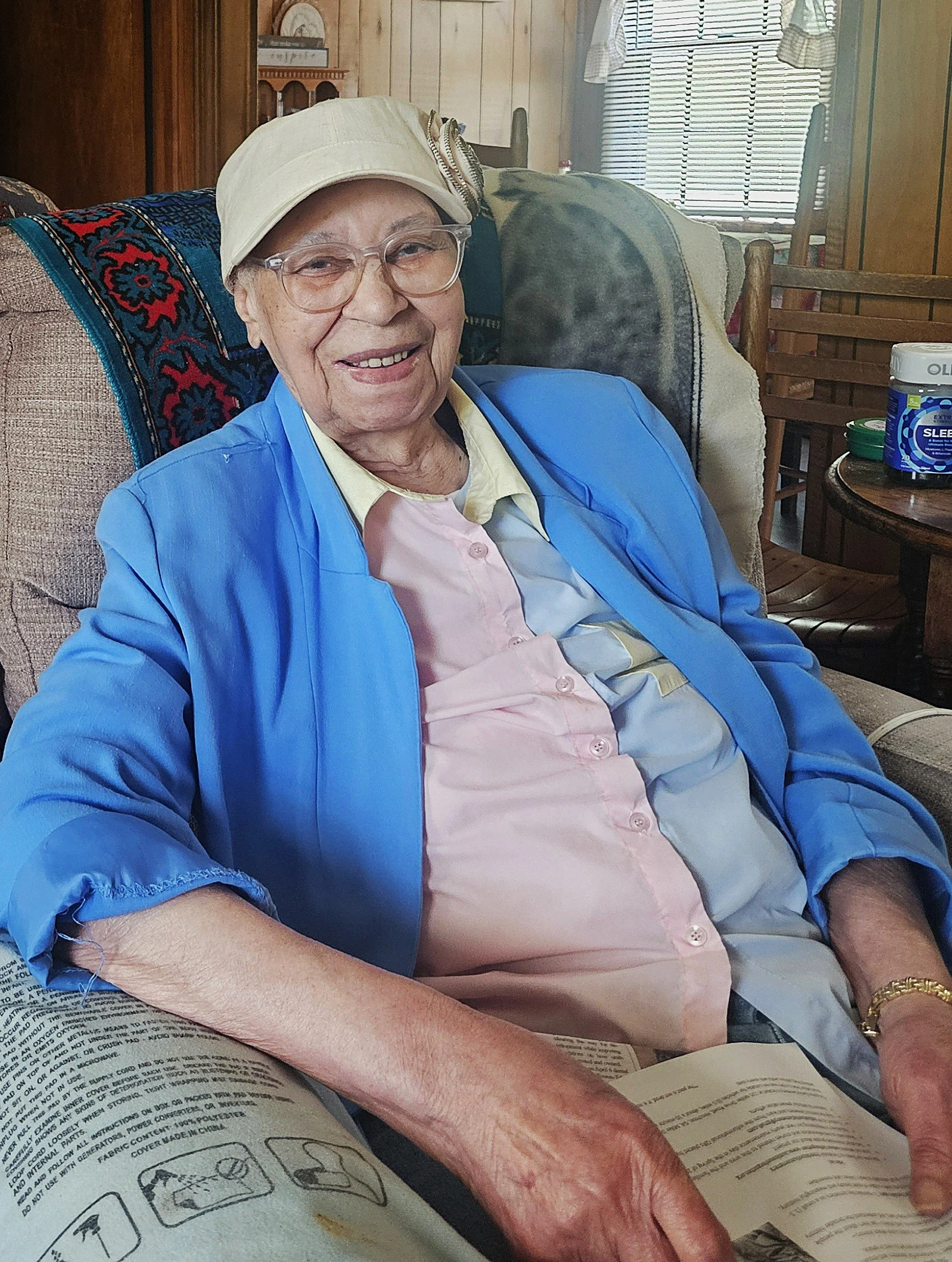
Lucille Moon Law from Commerce, Georgia. (interviewed May 14, 2026)
We were lucky to meet Mrs. Lucille (nee Moon) Law at her home in Commerce, Georgia during our May 2026 week of preservation work at the Justice Cemetery. Mrs. Law had reviewed the summary of the October 30th, 2025 interview (posted here to the left) and offered us some corrections and additional memories of the days of her youth when in the 1930’s to 1950’s she and her family owned the property around the cemetery and were part of a Black farming community.