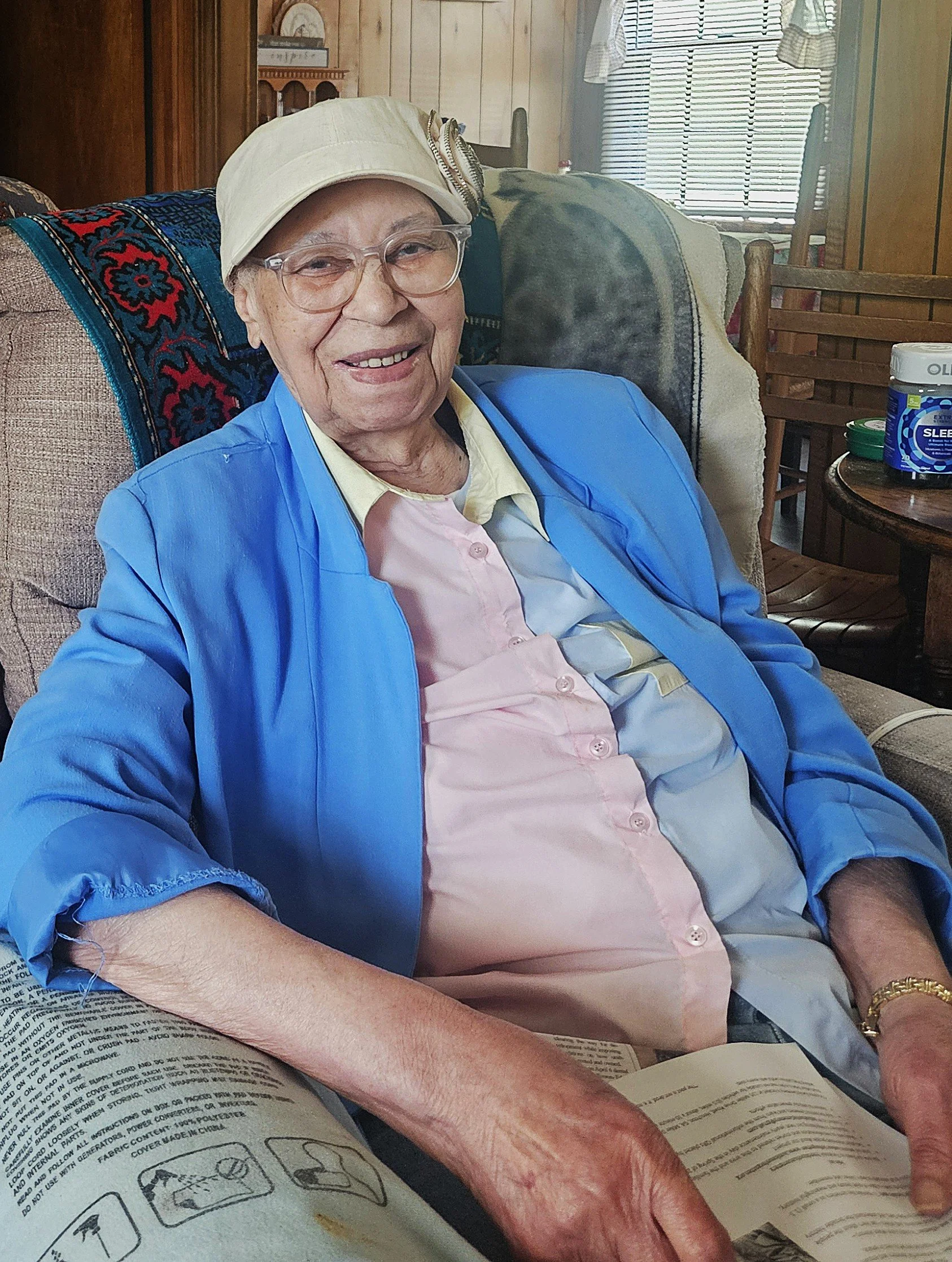
Lucille Moon Lawfrom Commerce, Georgia. (interviewed May 14, 2026)We were visited Mrs. Lucille (nee Moon) Law at her home in Commerce, Georgia during our May 2026 week of preservation work at the Justice Cemetery. Mrs. Law had reviewed the summary of the October 30th, 2025 interview (posted here) and offered us some corrections and additional memories of the days of her youth when in the 1930’s to 1950’s she and her family owned the property around the cemetery and were part of a Black farming community.
Going to Mr. Hugh’s convenience store:
To go to Mr. Hugh’s house you had to get down there on the pasture and walk all the way down past Uncle Bill’s house to get to Miss Perlisse's house. It was a beautiful spot. Like those pictures on TV where you see meadows. That is how pretty it was. Mr. Hugh’s convenience store was not connected to his house. It was nearby. He was never in the store so you would go on to knock on his house and let him know that you were coming to the store. He would go unlocking whatever you need. We were always so happy when his wife Miss Livy, that’s what we called her, would be there to go and open the store, because she would reach in a box and get a stick of candy and break it half in two and give halves to us. And we would be so happy!
When I graduated 7th grade
I remember when I graduated from 7th grade. On down there there was a branch (stream) before you get to the river and on the other side of the branch there was a rock. Oh man!. That rock is higher than this house. We would cross to the other side of that little stream. When I graduated from the 7th grade I spoke from that rock and my Daddy and all were on this side of the branch listening to what I spoke!
Working my Daddy’s farm
I was saying this last night at church about the songs people sang. In the old days during slavery if it not been the songs in the hearts that people sang they would not have made it. They communicated with songs. They shared information. “I let my sorrows down by the riverside” meant he was going to leave this plantation and get gone. Growing up by the (Justice) cemetery many times - my dad had 180 acres - we grew cotton, corn, peanuts and everything we needed - many times when pulling cotton in dry weather like this we make sure we get it done before it rain, so we sang our way through. There were many, many songs and my brother Bud (Gilliard Reid Moon) could make up songs easy.
Harmony among the races when I was growing up in rural Jackson County?
We, our family, treated one another and everybody else the same way. We were not for “segregation” but for sure we had hostility from the whites.
The shooting at my brother Bud and my cousin
There was also that white man who went shooting at my brother and my cousin. He was sat on a porch and you had to go up by his house. My cousin and my brother Bud, that is Mike’s dad (Gilliard Reid Moon), they came down there and want to walk this way home with the other. And Papa told them: "You all can't walk that road cause there is that white guy and he is going to shoot you all one day." But they kept doing it up and down the road with each other. One day that man started shooting at them. Yes he did! With a shotgun. And we couldn’t get to church and hold church with that guy up that road. They had to get that man moved out of the place. That was a public road! Eventually my Dad talked to whoever rented the man the house and got him moved.
The water fountain cup
Now this may sound strange because many of you never heard me say it: The way we grew up, with all these people Black and white in the same community…we (our family) did not ‘segregate’ and we treated one another and everybody else the same way. But when we went to the Braselton store to buy something, there was always “the cup” (for Blacks) hanging up at the water fountain. So my Dad told us: “Do not ever be thirsty when you go to that store.” He would not allow us to drink from it.
Insults from drunken whites driving up and down on election day
Growing up in the 1930s and 1940s during voting time there was a lot of white folks who got drunk and they would ride up and down the road and they would call us names. And my Dad would protect us by making us stand in the back of the house and he sat on the porch with his gun by his right side because they go by calling us names and everything, but if they were gonna shoot at him he would shoot back. He would sit there and protect us from those crazies, because as children are if they had called us names we’d have thrown rocks at them, but my Dad made us sit in the back. He protected us while teaching us all the time to treat everyone fairly.
My father protected us and let it be known
For sure there was hostility from the whites. My father knew them all and was even related to some of them. He knew exactly which ones to say a word to. He let it be known that “if you think you are going to do something to my family, you think you are going to shoot somebody, bring up the hearse with you because somebody will leave dead.” He made that very clear.
About slavery and the crimes of the past
My grandmother, my mother’s mother, came from Virgingia. We don’t know how many owners she was sold to before getting here to the Moon plantation That is the way it was when they were selling slaves. Parents were taken away from their children. The mother was taken away from her children. The girls were like teenagers. The plantation owners needed the boys to work in the farming and they wanted to keep the girls because most of them were going to have babies by these girls. That is why most of us don’t know who we are. It all makes me sad. Much, much reckoning, a whole lot of reckoning, need to be done. I have asked myself: Was slavery a part of God’s plan? Or was this something that man just decided to do himself? Because man can decide on his own! Much reckoning still needs to happen. But (when talking to a white person) I look at it this way: Why should I hold you responsible? Why should I have anything against you based on something your fore-parents did and that you have nothing to do? You can’t help where you come from. You can’t help what they have done. You did not do it. Don’t hold yourself responsible. What you need to do is to make good going forward, otherwise you would be doing what they done.