
Marcus, Georgia:
A School, a Post Office, and the Jackson County Nursery
A community of 22 in 1890 that no longer exists
Marcus School in the Justice-Flanigan farm
A small rural school was established at Marcus, in the Justice–Flanigan farm, where a post office had operated for decades. Its exact founding date is unknown. Perhaps it originated because John Gillam Justice—listed as a teacher in the 1850 census—valued education and fostered a community school, though the specific circumstances remain undiscovered.
Early Mentions and Community Life
The Marcus School was mentioned intermittently in the Jackson Herald after 1912, showing that despite its limited resources, it was a lively center of local learning and civic activity:
• March 3, 1912: “Elwood. The Elwood boys will meet at Marcus school house next Friday night, and speak. A joint debate with the boys over there. Everybody is invited. We are expecting a lively time.” — Jackson Herald
• March 20, 1913: “Marcus. Our school is still flourishing at this place. Several of the boys at this school have joined the Boys’ Corn Club, and we hope several more will join.” — Jackson Herald
The 1915 Educational Survey
The 1915 Educational Survey of Jackson County, Georgia, conducted by M. L. Duggan, provides the most detailed description of Marcus School:
• Teacher: O. G. Lancaster
• Grounds: 2 acres; reversionary (title to revert to the owner if the school ceased to exist)
• Setting: Oak grove, well cleaned but otherwise unimproved; small playgrounds; one toilet in poor condition; no school garden
• Building: One unpainted classroom, no cloakroom; poorly and improperly lighted but well kept; double homemade desks; very poor blackboard; no maps, charts, globe, pictures, library, or other aids; a shared drinking dipper
• Program: One teacher, seven grades; 35 pupils; school year – 24 weeks divided into terms of 16 and 8 weeks; no industrial work or clubs
This snapshot portrays Marcus as a typical early 20th-century rural Georgia school, limited in materials but reflecting local commitment to education.
Continued Operation
• July 1, 1920: “Marcus. School will begin at this place Monday, July 5th.” — Jackson Herald
• February 16, 1922:“The literary society of Marcus School met February 10th, and a Georgia Day program was rendered as follows: Song by school: ‘Georgia Land’, ‘Settlement of Georgia’ by Emma Cochran, ‘Facts About Georgia’ by Lester Bennett, Essay: ‘The Cherokee’ by Rose Nellie Cochran, and ‘James Oglethorpe’ by Lillie May Reynolds.” — Jackson Herald
• July 6, 1922:“Marcus School will begin July 10th. All pupils are requested to meet at the school building at 8 o’clock promptly. — Louise Johns, teacher.” — Jackson Herald
• September 2, 1926: “Notice. The debating society which was called off at Marcus school house some time ago will begin again next Saturday night, September 4th, at 8 o’clock. Everybody remember the date and be at hand for a good time. Some good speakers will be there at that time. — W. B. Bryant.” — Jackson Herald
Closure and Aftermath
• May 2, 1929:“Marcus. School closed at this place Friday with Miss Nell Freeman as teacher. She has returned to her home near Arcade.” — Jackson Herald
• June 8, 1933: “Accused of Arson Found Not Guilty. Friday night last week the Marcus school building, located on what was formerly known as the Flanigan farm, was burned. Frank Day was arrested for the crime.” — Jackson Herald
The arson marked the physical end of the school. By December 15, 1938, the Jackson Herald noted: “‘Marcus’ post office was at the home of the late A. M. Flanigan. There was also a schoolhouse near this post office, called by the same name. There is now neither post office nor schoolhouse there.”
Even a decade later, the site lingered in memory:
• August 19, 1948:“Revenue officers destroyed a large distillery in the vicinity of the old Marcus schoolhouse last week… The farm on which the distillery was found is known as the Collins place, now owned by the estate of L. C. Allen.” — Jackson Herald ( L. C. Allen had been a neighbor of the Flanigan property in 1918.)
The other pupils: Black Children, Separate and “practically without equipment”
During his 1915 Educational Survey of Jackson County Mr. Luggan also visited the Gum Springs School, likely near Marcus, and one of 15 schools for African Americans in Jackson County at the time. Gum Springs School had one teacher and 51 pupils, 5 grades, and prioritized “sewing, wood work” and doing so “practically without equipment.” The teacher’s name was Ms. Fannie Wilson.
The work of teachers O. G. Lancaster, Louise Johns, W. B. Bryant, Nell Freeman and others who taught at Marcus School as well as Ms. Fannie Wilson and those who taught at nearby Gum Springs School was important. We cannot know, but we hope that these educators used the tools they had to moved the children a step closer to each other on the long road towards one community.
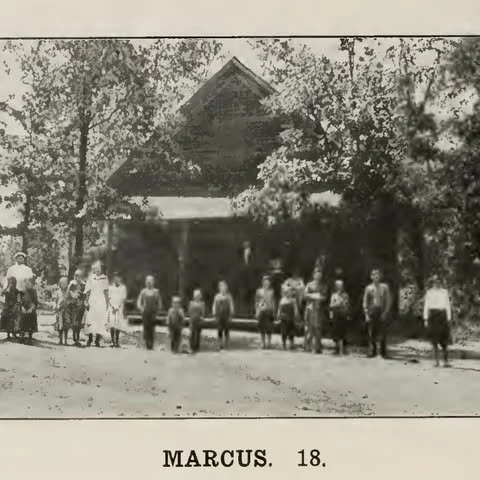
The 1915 Educational Survey
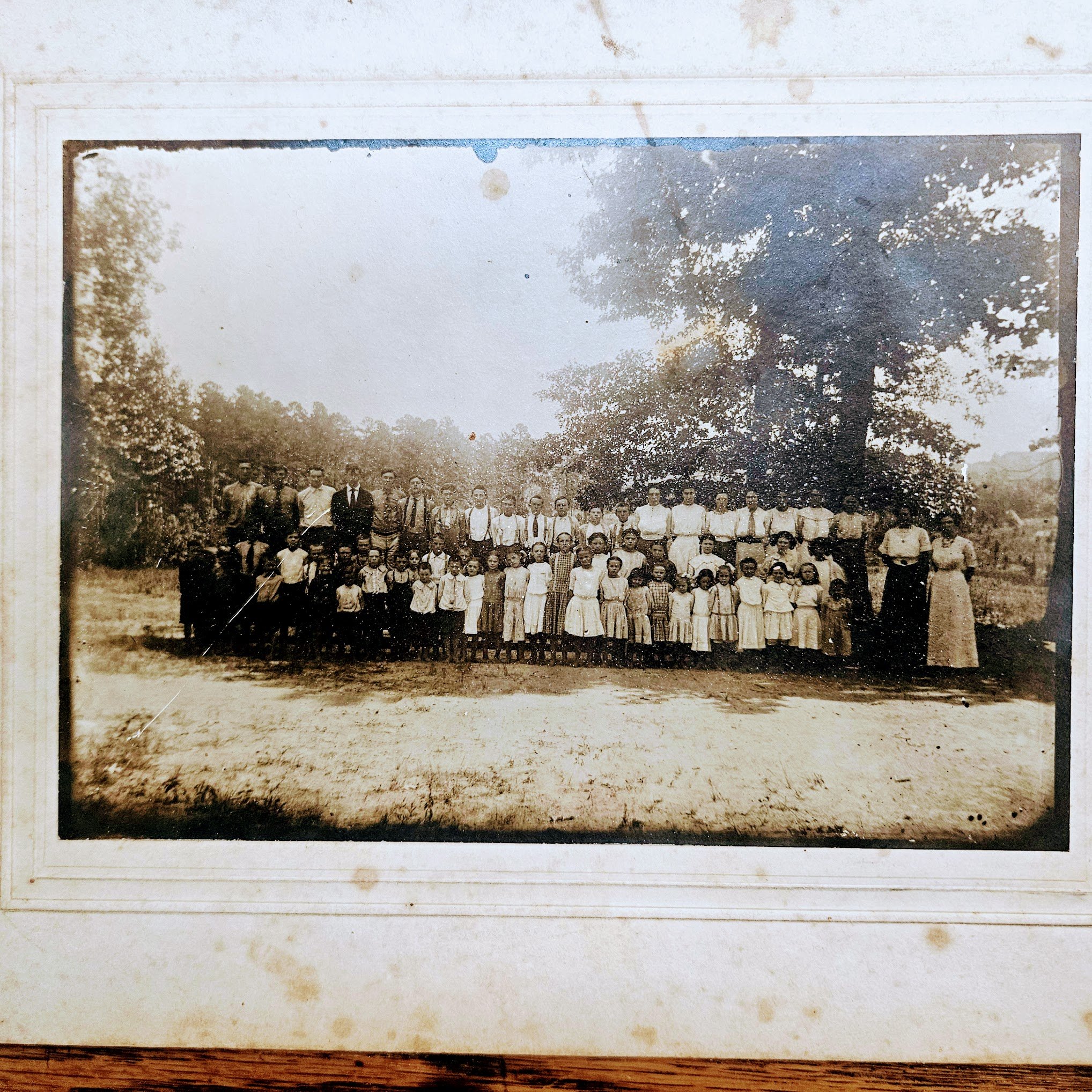
Summer 1911 Teachers Fannie Clifford and Colleen Lurline
Original in the Jackson County Historical Archives
Marcus School 1911
Marcus Post Office in the Justice-Flanigan Farm
The Marcus Post Office Jackson County, Georgia
The Marcus Post Office once stood on the farm of the Justice and Flanigan families in rural Jackson County, Georgia. It served as the communication lifeline for the small farming community that grew around the Justice homestead. Over the decades, Allen Justice (1793–1858), his son-in-law John Moorman Venable (1827-1910), and Allen’s daughter Susan Melvina Justice Flanigan (1828-1904) each served as postmasters.
Origins of the Marcus Post Office
The first rural post office in the area was the Mulberry Post Office, established in 1838 on the Lyle family farm, with Dilmus Reid Lyle (1774-1847) as postmaster.
A few years later, in 1846, Allen Justice secured the establishment of a post office on his property. This office was named Marcus, for reasons now lost to time. From that point forward, Marcus, Georgia became a recognized community on the map. Allen Justice was appointed the first postmaster on October 14, 1846.
After Allen Justice’s death in 1858, his son-in-law John Moorman Venable took over the post office, appointed on June 16, 1859. Venable likely served until joining the Confederate Army as a lieutenant (later captain) in Company B, 16th Georgia Infantry Regiment. During the Civil War, a family member likely continued postal duties at Marcus.
Disruption and Restoration
Both the Marcus and Mulberry post offices were temporarily discontinued on September 28, 1866, during the Reconstruction period.
At that time, Dilmus Reid Lyle of Mulberry was denied a presidential pardon by President Andrew Johnson because of his role in Georgia’s secession—Lyle had signed the Georgia Ordinance of Secession in 1861. He appealed for pardon, affirming his loyalty to the Constitution and support for emancipation. The provisional governor endorsed his plea, calling him “only a country postmaster.” The Mulberry Post Office was reestablished in 1872, and Lyle was restored to his position. The Marcus Post Office was reestablished around the same time, with Susan Melvina Justice Flanigan, the daughter of Allen Justice was appointed postmaster.
Decline of the Marcus Community
No record is available of when the Marcus Post Office closed, but it likely continued into the late 19th century—perhaps even until Susan Melvina Flanigan’s death at 75 in 1904.
The Marcus community included also a school and a commercial nursery, both active into the early 20th century and both used Marcus as their location name. However during the 20th century the name Marcus faded from use. Locals referred to the area simply as the “John G. Justice farm” or the “Flanigan farm”. In 1927, the property was sold at a sheriff’s sale, marking the end of the Justice and Flanigan presence. The Marcus School closed in 1929 and was sadly destroyed by arson in 1933—the final chapter of a once-thriving rural settlement.
The Marcus site and community exists only as a historic reference and as such the USGS Topo Zone map provides the following exact location: 34.0737199000, -83.6771137000.
The center of these coordinates is at the intersection of Jackson Trail Road and Gum Springs Church Road and it matches the 1918 plat of the “old John G Justice home place” owned by his nephew John Randolph Flanigan which describes several buildings (n=6) at the spot.
The Jackson Herald on December 15, 1938 informs: “Marcus post office was the home of the late A.M. Flanigan. There was also a school house near this post office, called by the same name. There is now neither post office nor school house there”
Today only the Justice Cemetery and family records remain to mark the place once known as Marcus, Georgia.
Where is Marcus, Georgia?
The Marcus site and community exists only as a historic reference and as such the USGS Topo Zone map provides the following exact location: 34.0737199000, -83.6771137000.
The center of these coordinates is at the intersection of Jackson Trail Road and Gum Springs Church Road and it matches the 1918 plat of the “old John G Justice home place” owned by John Randolph Flanigan which describes several buildings (n=6) at the spot.
The center of Marcus, with homes, post office services and Nursery business buildings is approximately a mile from the Justice Cemetery.
The 1895 Rand McNally and Co. map of Georgia shows the location and reports it having 22 residents ( likely based on the 1890 census) and a post office.
Mchttps://vault.georgiaarchives.org/digital/collection/hmf/id/42
1848 MAP of MARCUS, GA
1855 MAP of MARCUS, GA
1881 MAP of MARCUS, GA
1899 MAP of MARCUS, GA
Decline of the Marcus Community
The Marcus community included also a school and a commercial nursery, both active into the early 20th century and both used Marcus as their location name. However during the 20th century the name Marcus faded from use. Locals referred to the area simply as the “John G. Justice farm” or the “Flanigan farm”. In 1927, the property was sold at a sheriff’s sale, marking the end of the Justice and Flanigan presence. The Marcus School closed in 1929 and was sadly destroyed by arson in 1933—the final chapter of a once-thriving rural settlement.
The Marcus site and community exists only as a historic reference and as such the USGS Topo Zone map provides the following exact location: 34.0737199000, -83.6771137000.
The center of these coordinates is at the intersection of Jackson Trail Road and Gum Springs Church Road and it matches the 1918 plat of the “old John G Justice home place” owned by John Randolph Flanigan which describes several buildings (n=6) at the spot.
The Jackson Herald on December 15, 1938 informs: “Marcus post office was the home of the late A.M. Flanigan. There was also a school house near this post office, called by the same name. There is now neither post office nor school house there”
Today only the Justice Cemetery and family records remain to mark the place once known as Marcus, Georgia
The Jackson County Nursery of Marcus
John Gillam Justice (1825–1910)
John Gillam “J.G.” Justice was born on November 1, 1825, to Allen and Susan Justice, their first son. He grew up working on the family farm in Jackson County, Georgia. Bright and ambitious, he was drawn to both education and business. By 1850, at age 25, he was working locally as a teacher.
After his father’s death in 1858 and in the years leading up to the Civil War, John was living in Hartwell, Georgia, where he worked as a merchant and was involved in small-scale manufacturing. Unlike his brother Allen T. Justice and several other relatives, John did not enlist in the Confederate Army. He likely received an exemption—possibly as a teacher, or under agricultural and merchant provisions designed to preserve essential community functions.
Following the war, John returned to Jackson County and assumed responsibility for his family’s farm and household. He cared for his elderly mother, Susan (then 74), as well as his sister Susan Melvina Justice, the widow of John Flanigan (age 36), his sister Mary Ann Kissah Justice (31), and his young nephew, Allen Monso Flanigan (6). Also living in the household were two African American boys, Henry (13) and Joshua Moore (9), born in Virginia, who worked as farm laborers. John Gilliam Justice never married.
Peaches in Georgia
Educated, practical, and enterprising, John Justice had an eye for opportunity. While peaches had grown in Georgia since Spanish colonists first introduced them in the 16th century, before the Civil War they were raised mostly for household use or limited local markets. The expansion of railroads in the 1870s changed this. Fresh fruit could now be shipped north, and new peach varieties better suited to shipping—firmer, later-ripening types—were being developed. By the late 1870s and early 1880s, the first large commercial shipments of Georgia peaches were moving to Atlanta, Augusta, and beyond.
Recognizing this potential, John Gillam Justice established the Jackson County Nursery in the early 1870s. He successfully operated it until his death in 1910. As early as 1878, The Forest News of Jefferson published a customer’s testimonial:
“Mr. J. G. Justice, Marcus, Ga. Dear Sir—The fruit trees I obtained from your nursery four years ago are now bearing, and the fruit comes fully up to your representation. It is the finest I have ever raised…” (Forest News, Jefferson, June 8, 1878).
Nearly three decades later, The Jackson Herald praised his work:
“Peach trees from the Jackson County Nursery made Peach Mountain …$10,000. The trees from this nursery are the best in the world.” (Jackson Herald, Jefferson, April 18, 1907).
John Gillam Justice’s Jackson County Nursery was thus active at the very start of Georgia’s commercial peach boom. He was among the first wave of nurserymen providing improved peach varieties to farmers eager to establish orchards for profit.
He died September 22, 1910. His marker at the Justice Cemetery, between his mother and his sister Martha, reads “With life and name unstained the good man dies”.